ADVERTISEMENT
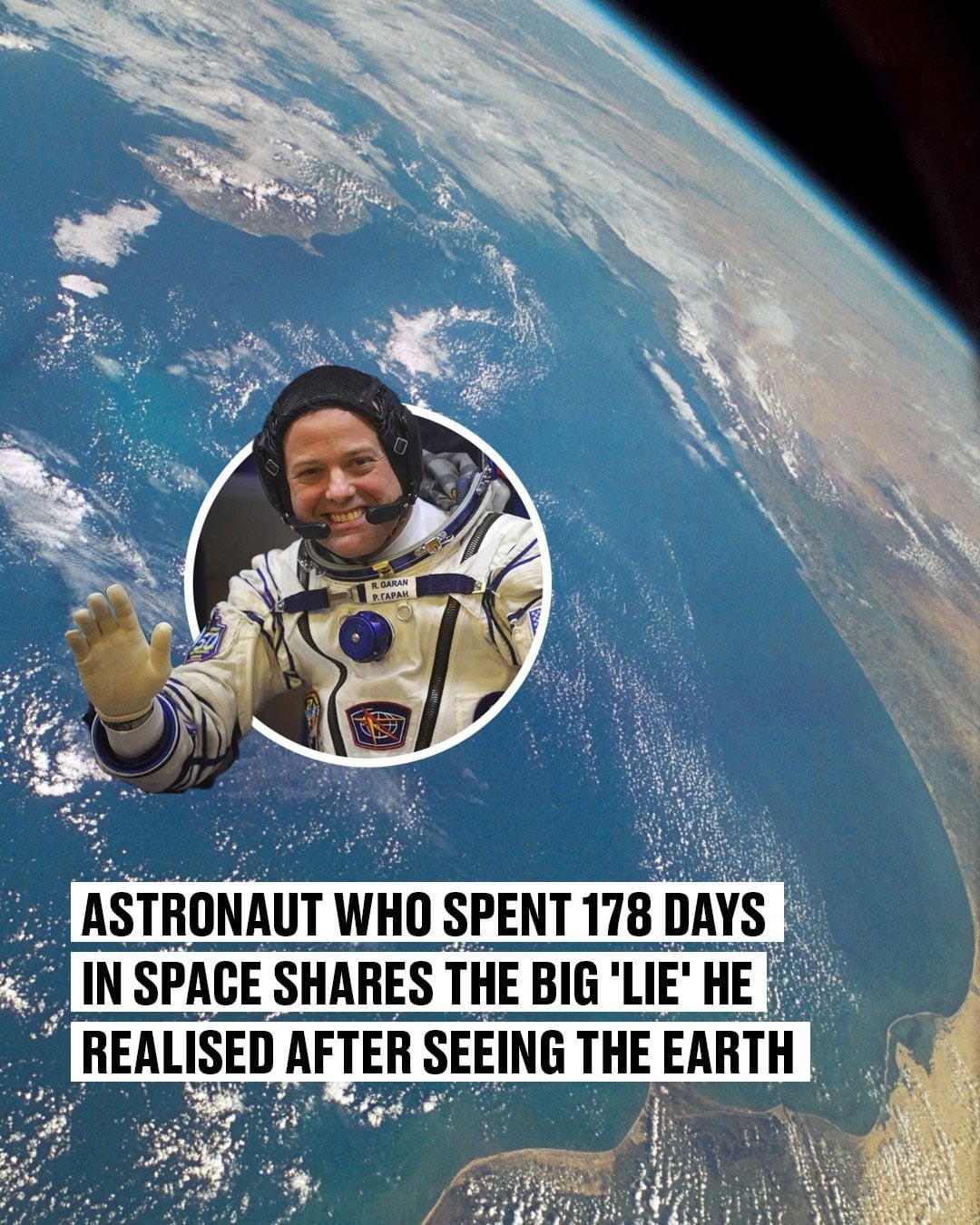
From orbit, Garan observed:
The thinness of Earth’s life‑supporting atmosphere, so slender yet essential that without it every living thing would perish.
A lack of visible evidence of economic systems — the invisible networks and structures that dominate life on Earth’s surface.
In his own words, he realized that human society treats everything, including the planet’s life‑support systems, as secondary to economic priorities. That perspective — that economic growth and financial systems should be central to human existence — is what he calls the “big lie.” From space, that worldview collapses. The needs of the planet come first, then society, and only then can economies function in a sustainable way.
This wasn’t just a personal insight — it was a broader critique of how we think about progress, growth, and human purpose.
Earth as a Single System
One of the most striking aspects of Garan’s experience is how clearly Earth presents itself as a single entity from space. There are no lines marking borders; no images of national flags or divisions; no visible signs of wealth distribution. Instead, there’s only one interconnected system — a closed ecological unit with a finite supply of air, water, and life.
This viewpoint echoes what many astronauts have described following space travel: that seeing Earth from above makes human conflicts and priorities seem small in light of the reality that we all share the same home.
Garan has often emphasized that Earth isn’t just a planet; it’s more like a spacecraft — a single vessel carrying billions of inhabitants through the void, completely dependent on its life‑support systems. Yet on Earth, we often treat those systems as if they’re inexhaustible or unimportant, prioritizing short‑term gains over long‑term survival.
What the ‘Overview Effect’ Teaches Us About Ourselves
For Garan, the experience highlighted a stark contrast between:
Earth’s fragile ecological reality — a blue marble blanketed by an almost invisible atmospheric layer, and
Human societal constructs — economic systems, geopolitical divisions, cultural rivalries, and competitive hierarchies that seem vital on the ground but vanish from space.
Viewed from orbit, the things we argue over — borders, wealth, political ideology — disappear. What remains is a shared home whose continued health is essential for all life. Many astronauts emerging from the Overview Effect speak about an increased sense of responsibility and purpose — not just for themselves, but for humanity’s collective future.
How This Insight Challenges Humanity’s Priorities
Garan’s revelation is not simply a philosophical observation; it’s a call to action.
If humans truly understood Earth as a fragile, interconnected system, he suggests, many of our biggest issues — climate change, environmental degradation, inequality, and conflict — might be approached differently. Instead of prioritizing economic growth at all costs, we would place planetary health first, followed by society, and then economic systems.
In essence, Garan’s message is both urgent and universal: unless humanity reorients its priorities toward preserving the planet that sustains life, we may be setting ourselves up to fail. This perspective is not just idealistic; many scientists argue that global problems require global solutions — something only achievable when we see Earth as one integrated system.
A New Lens for Understanding Our Place in the Universe
What makes Garan’s experience compelling — and important — is that it invites us to consider what it means to see beyond ourselves.
Most of us will never travel to space. Yet there are ways to cultivate a similar sense of connection, humility, and purpose that the Overview Effect inspires. From awe‑inspiring images like the “Blue Marble” photograph to virtual reality simulations designed to mimic space views, researchers have explored how experiencing Earth from afar can shift human consciousness.
Such explorations may help translate what was once the exclusive domain of astronauts into something more accessible. If people on Earth can glimpse the wholeness of our planet, even through simulated experiences, perhaps our collective understanding of responsibility and unity could grow.
Why This Matters for the Future
Astronaut Ron Garan’s realization underscores a crucial truth: perspective shapes reality. The way we see the world influences the decisions we make, the policies we support, and the values we uphold. When Earth is seen not as fragmented territories but as a single, interconnected system, attitudes toward cooperation, sustainability, and shared purpose shift dramatically.
His insights echo a growing movement in science and philosophy that advocates for planetary citizenship — the idea that humans must think beyond national boundaries and short‑term gain, working together to protect the only home we have.
The “big lie” Garan spoke of isn’t a conspiracy theory — it’s the collective blind spot in how humans define success, power, and progress. In emphasizing economic growth above all else, society often overlooks the foundational systems — the biosphere, climate, and ecosystems — without which nothing else can exist.
Conclusion: A Perspective Worth Sharing
Space exploration has always been a testament to human ingenuity — but its greatest gift may not be technological. It may be perspective.
Astronauts like Ron Garan remind us that when we choose to expand our view beyond ourselves and see Earth in its entirety, we uncover truths that matter for the survival of all species.
Whether or not humanity heeds this wake‑up call remains to be seen. But one thing is clear: the lessons learned from orbit are too profound to be ignored. What happens when we look beyond borders, beyond economic systems, and beyond division — and see Earth for what it truly is: a single, fragile, and beautiful home?
That question may be the most important one we ever ask.
ADVERTISEMENT
